Sunday, March 29, 2026

Unpacking the New White House App


So, the White House just dropped a mobile app. In a world where we have an app for everything from tracking our sleep to finding the best gluten-free taco, the executive branch has decided it needs a permanent home on your home screen. On the surface it’s being pitched as a way to get unfiltered updates straight from the source, bypassing the traditional media gatekeepers. But if you’re like me (a little tech-savvy and naturally skeptical of anything requiring a system-level handshake) the permissions list is where the real story begins.

This isn’t just about getting push notifications for the latest executive order. We are living through a massive decline in public trust in government institutions, and dropping a data-hungry application into that environment is a bold move to say the least. Is this a genuine attempt at transparency, or are we looking at a sophisticated piece of civic software designed to keep a much closer eye on the citizenry? Let’s peel back the UI and see what’s actually under the hood.

News, Affordability, and an ICE Tip Line

Press enter or click to view image in full size

The app’s interface is exactly what you’d expect from the current administration. High-energy, heavy on media, and very focused on direct interaction. According to official White House release notes, the Direct Line app includes live streams of briefings, a news feed of press releases, and even an affordability tab that tracks the cost of common goods. It’s a masterclass in direct-to-consumer politics. By creating a proprietary feed, the administration can frame every narrative without the pesky context or fact-checking that usually comes from a third-party news desk. It’s the ultimate vibe check for federal policy delivered in 4K resolution directly to your pocket. The inclusion of an affordability tracker is particularly clever. It positions the app as a tool for your wallet, a move likely aimed at the 41% approval rating the administration is currently navigating. If they can convince you the app helps you save money on eggs, you’re much more likely to ignore the more invasive toggles in your settings menu.

The most eyebrow-raising feature, however, isn’t the policy updates. It’s the integrated ICE tip line. This allows users to report information directly to Immigration and Customs Enforcement with a few taps. While the administration frames this as community cooperation and a way to restore the rule of law, it’s hard not to see it as a digital version of the old see something, say something campaigns.

Now supercharged by mobile convenience. It effectively gamifies federal enforcement, turning your smartphone into a reporting terminal. This isn’t just a passive news app. It’s an active participation tool that encourages citizens to act as an extension of the state’s surveillance apparatus. Reports are already circulating that this tool isn’t just for immigration. it’s part of a broader push to monitor dissent. Where hyperbolic social media posts are being reclassified as credible threats. When an app moves from reading the news to reporting your neighbor, the social contract starts to look a little different.

Why Does the Government Need My Location?

Press enter or click to view image in full size

Here is where the friendly creator in me starts to get a nervous twitch. When you install a new app, most people just mash the Allow button to get to the content. But the app store privacy disclosures for the official White House app suggest a level of data collection that feels a bit…intimate for a news reader. We’re talking about identifiers linked to your identity, contact info, and usage data that can be used for marketing. Now, marketing in a government context usually means voter targeting or narrative reinforcement. If the government knows exactly which articles you linger on and which ones you swipe past, they aren’t just informing you, they’re profiling you. The app reportedly asks for access to your biometric sensors and storage modification, which has led some privacy advocates to label it state-sanctioned spyware.

Why does an app meant to inform you about the President’s schedule need to track your device ID or have your phone number? The App Store Accountability Act has already sparked debates about how much sensitive data (like government IDs and biometrics) should be floating around the app ecosystem. If the government is the developer, the line between user analytics and population surveillance gets real blurry, real fast. Think about it. If they have your location data, they know if you attended a protest, a rally, or a specific town hall. They know your routine. In the hands of a private company, this data is used to sell you sneakers. In the hands of the state, it can be used to map the movements and associations of its citizens. The administration’s own privacy policy notes that information you share can be treated as public and shared with other law enforcement agencies. That’s a lot of power to hand over just to see a livestream of a press secretary.

Tracking the Masses or Just Cutting Through the Noise?

Press enter or click to view image in full size

The timing of this release is fascinating if you’ve been following the 2026 National Cyber Strategy. The administration has been very vocal about unleashing the private sector and modernizing federal networks with AI-powered defenses. This app looks like the consumer-facing side of that modernization. Away to bridge the gap between high-level policy and the average person’s screen time. By moving the conversation to a proprietary app, the White House effectively creates its own walled garden. Within this garden, they control the algorithm, the notifications, and the data. It’s a brilliant way to bypass social media platforms that might slap a missing context label on a post. It also comes amid a bipartisan push for the Government Surveillance Reform Act, which aims to stop the government from buying private data from brokers. If they can get you to volunteer that data through an app, they don’t even need the brokers anymore.

Critics argue that this is the ultimate mission creep. We’ve already seen reports of ICE using AI surveillance and facial recognition to identify individuals without warrants or traditional oversight. Integrating a reporting tool into a mainstream government app feels like the next logical step in crowdsourcing surveillance. It’s the Uberization of law enforcement. Is the point to share info, or to turn every smartphone into a node in a massive, government-run data network? When you combine intrusive permissions (like access to your contacts and precise location) with a direct line to law enforcement, the unfiltered news starts to feel like a very shiny bait-and-switch. This is happening at a time when ICE has been caught using tools to spy on entire neighborhoods by collecting cellphone location data without a warrant. It raises this question. Is the app serving you, or are you serving the app?

To Download or Not to Download?

Press enter or click to view image in full size

Look, I’m all for government transparency. In a world of deepfakes and AI-generated misinformation, getting a primary source for policy is objectively a good thing. We need more clarity, not less. But we have to ask ourselves what we’re trading for that direct line. If the price of staying informed is handing over my location data, device identifiers, and browsing habits to an administration that is actively building out a massive cyber-deterrence and enforcement framework, I might just stick to the RSS feed or the official website on a hardened browser. There’s a fine line between a government that wants to talk to you and a government that wants to watch you, and this app seems to be dancing right on top of it.

The big question moving forward isn’t just what the app does today, but what it becomes tomorrow. With AI agents becoming more proactive and system-level permissions becoming more powerful, the potential for this app to evolve into something much more invasive is high. Are you ready for your phone to start suggesting things to report based on your location? Or for the government to know your affordability concerns before you even post about them? The Direct Line is open. Just make sure you know exactly who’s on the other end of the wire before you pick up. If you’ve already hit download, it might be time to check those permission settings. Or maybe just factory reset the whole thing and start over. No I am just kidding. Do not do that….

These are just my thoughts. It is always good to do your own research before you download any new app. The timing of this just seems a little off to me. Who am I though to question the government.

Thanks for reading everyone! Visit my site to learn more about me and explore what I’m building at Learn With Hatty. I hope everyone has a great day and as I always say, stay curious and keep learning.

Original article on BULB

Thursday, March 26, 2026

AI Is Everywhere, and It's Exhausting


I remember when AI felt like a cool toy. You opened up a chatbot, played around with a few prompts, maybe had it write a dumb rap about your dog or even a funny picture, and that was it. Now it feels like every app, every job, every device is quietly whispering, “Have you tried doing that with AI?” It went from fun sidekick to clingy coworker in about two years.

In 2026, AI isn’t just a thing you use anymore, it’s the water we’re all swimming in. Work tools, browsers, phones, cars, creative apps, etc. Pretty much everything wants to assist you, optimize you, and nudge you into the AI lane. Reports like MIT Sloan’s overview of AI and data science trends for 2026 make it clear this isn’t a phase, it’s the new default.

When Every Tool Thinks It’s an AI Platform

1*xWAF00cL9kZDQd0z3pT3Gg.jpeg

There’s this phrase that keeps popping up in the reports. AI is becoming infrastructure. The MIT Sloan article on five trends in AI and data science for 2026 talks about generative AI moving from experiments to systematic, organization‑wide use. Not as a toy you dip into but as a standard layer in how work gets done. Forbes’ piece on AI trends that will shape business in 2026 says the same thing in business‑speak. AI is weaving into core processes, not just sitting in side projects. CompTIA’s AI Trends to Watch in 2026 literally frames AI as something that will be baked into tech stacks rather than bolted on.

What that feels like as a normal human is. Every tool has an Ask AI area bolted onto it now. Your doc editor offers AI outlines. Your email drafts itself. Your CRM wants AI insights. Your calendar wants to “optimize your day.” Your video editor suggests AI cuts, captions, and B‑roll. Your browser has AI search on by default. At some point you realize we are not just using AI, we are being surrounded by it.

For people like me, who already wrestle with mental health and time management, this can feel less like help and more like a new layer of pressure. It’s no longer, “Do you want to use AI?” It’s, “Why aren’t you using AI for this? You’d be faster, better, more productive.” The subtext is that doing things the slow human way is now kind of suspicious or inefficient, even though those same AI trend reports warn about over‑automation and the risk of ignoring human limits.

The Silent Expectations at Work

1*KJQ_XoxLHPuEf1SObi2Cfw.jpeg

Work is where the creep really shows. A lot of 2026 research says organizations are moving from one‑off AI experiments to AI everywhere, especially in knowledge work. Harvard Business Review’s piece on nine trends shaping work in 2026 and beyond talks about AI and automation as one of the big forces reshaping jobs, with employees expected to adapt, upskill, and collaborate with machines instead of just doing their old tasks the same way. CompTIA’s 2026 AI trends basically says AI literacy is becoming baseline rather than bonus.

That sounds reasonable right? In real life, it feels like you’re always behind. Didn’t learn the new AI feature? You’re resistant to change. Didn’t automate enough of your workflow? Maybe you’re not leveraging your tools properly. Quietly, the bar keeps rising. The same reports that hype AI productivity also warn that without real governance, human‑centric design, and limits, AI deployments can backfire and create more stress instead of less.

For creators, it’s a double hit. You’re expected to use AI to keep up. Thumbnails, titles, scripts, and clips all while also competing against AI‑generated content flooding every platform. It’s like lining up for a marathon where half the runners secretly brought bikes.

AI in Your Pocket, Your Browser, Your Car

1*YQaXQ0YuBRQ30FjxOoHgrA.jpeg

The other thing making this all feel so intense is how physical it’s gotten. Deloitte’s 2026 Global Hardware and Consumer Tech Outlook talks about PCs and devices being redesigned around on‑device AI and specialized NPUs. PC hardware coverage like PC Gamer’s there’s plenty of PC hardware to be excited about in 2026 frame this as a new wave of local AI, where laptops and handhelds run serious models without depending on the cloud.

On paper, that sounds cool. Faster, more private, less latency. In practice, it means smart is now the default. Your phone can summarize your notifications. Your PC suggests replies, search rewrites, and layouts. Your car can learn your routes and make suggestions. Your TV wants to recommend content based on your mood. Tech consulting pieces like CapTech’s 2026 Tech Trends: The Only Constants Are AI and Change describe this as a constant wave of AI‑driven personalization and automation across devices.​

You start to notice that fewer and fewer moments are just…quiet. Not optimized. Not nudged. Not analyzed. On a good day, that feels like convenience. On a bad day, it feels like your entire environment is gently pressuring you to always be doing more.

Privacy, Data, and the Feeling of Being Watched

1*YRTk0ewDr_OYxhAIywZklQ.jpeg

The other side of AI everywhere is data collection everywhere. Privacy folks have been sounding the alarm that AI is becoming a huge driver of data hunger. Osano’s 2026 privacy outlook, 5 Emerging Data Privacy Trends in 2026, warns that generative AI systems both rely on massive training datasets and consume vast volumes of customer data in day‑to‑day use. Creating new risks around profiling, surveillance, and regulatory violations. Another overview of data privacy trends for 2026 points out that plugging AI into every data flow makes it much harder to trace where sensitive information goes and how it’s repurposed.

Legal scholars like Woodrow Hartzog and Neil Richards go even further. In their op‑ed Big tech is hungry for consumer data. Mass. needs privacy legislation now, they argue that the AI race has intensified tech companies’ appetite for tracking us everywhere. They describe companies openly envisioning AI systems that constantly watch and record our actions through cameras and sensors embedded in public and private spaces, and they push for strong privacy laws because once that kind of infrastructure is in place, it’s almost impossible to undo.

Even if you never read those articles, you can feel the vibe. The always‑on microphones. The help improve our AI toggles buried in settings. The default share usage data checkboxes. The AI features that quietly opt you in until you dig around and turn them off. On a good day, it feels mildly creepy. On a bad day, it feels like you’re living inside someone else’s training dataset.

AI Culture, Authenticity, and Why Everything Feels Fake

1*NUjm210EDkO93bwLT9d3Pg.jpeg

There’s also the culture side of all this. Social media trend reports for 2026 keep repeating the same thing. People are tired of hyper‑polished, obviously AI‑generated content. Ogilvy’s Social Trends 2026: Social With Substance and the Return to Real talks about a return to real, where audiences crave authenticity, mess, and actual human stories because feeds are drowning in generic, low‑effort content.

At the same time, pop‑culture‑oriented pieces on AI note that AI‑generated music, images, and writing are blurring the line between what’s real and what’s synthetic. Articles looking at AI’s impact on pop culture in 2026 mention proof of humanity as an emerging vibe (showing your actual voice, face, and imperfections), because people don’t quite trust what they’re seeing anymore.​

If you’re someone who actually cares about saying real things, this is a weird place to be. You use AI to survive the creative grind, but you’re also competing against the flood that makes your audience suspicious. You’re told to be authentic, but you’re also nudged to crank out more content, faster, with AI help. It’s emotionally disorienting.

The Mental Load of Being “AI-Optimized”

1*j4b3x4ML2vP-vk2D6NQxjA.jpeg

A lot of the articles about AI trends sound excited. They talk about productivity, new business models, augmented workforces, and how AI will handle boring tasks so humans can be more creative. And to be fair, there is a real upside. I’m literally using AI to help shape this article. It saves time. It makes some things easier.

But there’s a quiet mental load nobody really prepared us for. You’re constantly making micro‑decisions. Should I do this myself or hand it to AI? Is this my voice or the model’s? Am I falling behind because I’m not automating enough? Is this prompt private? Will this data end up training something I don’t control? Every one of those tiny questions drains a little more energy.

The MIT Sloan piece on AI and data science trends warns that AI deployments that ignore human factors like workload, cognitive overload, and trust can backfire and increase stress rather than reduce it. Harvard Business Review’s work trends article says something similar. If organizations don’t pair automation with real support, clear expectations, and guardrails, they’re just piling more demands onto already stretched people.

For those of us who already deal with anxiety, depression, or just a lifetime of feeling behind, that’s a lot. The tools are supposed to help, but they can end up making you feel like you’re not productive enough, not adaptive enough, not AI‑powered enough to keep up.

Choosing When to Opt Out (On Purpose)

1*3MyjLn2y7JK6NS4cY_Uhqw.jpeg

So what do you do in a world where AI is basically the background radiation of daily life? For me, it’s become less about rejecting AI completely and more about drawing intentional lines. I’m okay using AI where it genuinely lowers stress. Like brainstorming, summarizing, cleaning up the structure of my ideas. I’m less okay with it in places where it messes with my sense of self or privacy, like always‑on tracking, auto‑generated personal messages, or systems that want full access to my files “to help.” Interestingly, some of the same reports that hype AI also recommend purposeful adoption. This is where organizations pick specific use cases and say no to the rest instead of slapping AI on everything just because they can.

There’s also some power in choosing slow lanes on purpose. Writing instead of always filming. Leaving some parts of your life unoptimized and unrecorded. Turning off features you don’t actually need. Not every moment has to be fed into a model. Not every thought has to become content.

AI is not going away. It’s going to go deeper into our tools, our jobs, and the physical stuff around us. But exhaustion is a real signal. If the constant push to be AI‑augmented is draining you, that doesn’t mean you’re broken. It might just mean you’re still paying attention.

1*Wn6u5tv4ITwimrEp05lXHA.gif

Thanks for reading everyone! Visit my site to learn more about me and explore what I’m building at Learn With Hatty. Remember, stay curious and keep learning.

Original article on BULB

Tuesday, March 24, 2026

Is AI Coming for Your Job?


AI really is coming for parts of a lot of jobs, but not in the simple robots take everything and we all sit at home way people like to tweet about. It’s more like a slow and messy rewiring of how work and money move through the economy, one upgrade at a time. Tasks that used to belong only to humans are being chipped away by software, while new kinds of work appear just as quickly in the background. The shift is already visible in the data if you look at which roles are shrinking, which ones are growing, and where companies are suddenly spending money on automation and AI tools, even though a lot of us are still stuck arguing about whether this might happen someday instead of noticing that it quietly started a few years ago.

Are the Robots Actually Taking Our Jobs?

Let’s start with the scary stuff, because it’s real and it’s already in the research. Analyses of automation and AI suggest that up to 300 million full‑time jobs worldwide are exposed to AI‑driven automation, especially in areas like office support, customer service, and certain professional roles. In broader automation scenarios, experts estimate that between 400 and 800 million workers may need to change jobs or be displaced by 2030.

A forecast from Forrester paints a similar picture for the United States. They project that about 6.1% of American jobs (roughly 10.4 million roles) could be lost by 2030 due to AI and automation, with newer generative AI systems responsible for about half of that impact. That makes it one of the most disruptive labor shifts we’ve seen in recent decades.

But it’s not all doom and gloom. When Morgan Stanley surveyed companies that have already adopted AI at scale, they found that these firms cut 11% of roles through layoffs and left another 12% of positions unfilled, yet they also created 18% more new jobs in AI‑complementary areas. Overall, that translated to about a 4% net job loss across those companies. Interestingly, the U.S. subset of that data actually showed a small net increase in jobs for early AI adopters, which suggests that in some markets, AI is reshaping work more than it’s simply wiping it out.

What’s Actually Changing Right Now (Not in 2035)

Let’s step back from the forecasts for a second and just look at what’s actually happening in the job market right now. If you do that, you can see AI’s fingerprints all over the present. A recent U.S. labor market update from Indeed’s Hiring Lab shows that overall job postings are only about 6% higher than they were before the pandemic, but jobs that explicitly mention AI have jumped by more than 130%. In fields like data and analytics, almost 45% of postings now include AI skills in the description. That’s a big shift. Employers aren’t treating AI as a vague “nice‑to‑have” bonus anymore. They’re baking it right into the core of what they expect from candidates.

On the flip side, researchers at the Federal Reserve Bank of Dallas zoomed in on the sectors that are most exposed to AI. These are jobs where large language models and related tools can already handle a big chunk of the work, like writing, coding, and basic analysis. They found that while total U.S. employment grew by about 2.5% between late 2022 and early 2026, employment in these AI‑exposed sectors actually shrunk by about 1%, with jobs in computer systems design down around 5%. That gap tells us AI isn’t just future‑hype. It’s starting to reshape how companies staff those roles today.

Anthropic also took a close look at this by building an AI exposure index for different occupations and matching it against real‑world labor data. They found that highly exposed jobs (like programmers, customer service reps, and financial analysts) aren’t yet seeing a clear spike in unemployment. But there is some early, tentative evidence that hiring is slowing down for younger and less‑experienced workers who are trying to break into those fields. In other words, it might not feel like mass layoffs yet, but the door is quietly getting a little harder to open for newcomers trying to get in.

Who’s in the Crosshairs, and Who’s Getting a Boost?

It’s easy to think AI will only replace factory or warehouse jobs. The kind of work that’s already been automated for years. But this wave is different I think. It’s coming after digital, cognitive work too, not just physical labor. Forrester’s 2030 outlook and related research show that the most vulnerable roles tend to be the ones that are heavy on predictable, rules‑based tasks. Think data entry, routine bookkeeping, basic customer support, document processing, and some legal and back‑office work. These jobs are made up of clear patterns AI can learn and replicate quickly, which makes them easier targets for automation.

A widely shared Forbes piece on the jobs that will fall first as AI takes over the workplace highlights roles like traditional telemarketers, certain back‑office banking jobs, and basic content and copywriting as some of the early casualties. Why? Because the work is relatively easy to break down into repeatable steps, and AI can already handle a lot of the grunt work like answering standard questions, filling out forms, or churning out boilerplate text.

That said, there’s a clear premium emerging for people who can ride the wave instead of getting crushed by it. A World Economic Forum analysis of more than 10 million job postings in one major market found that roles requiring AI skills paid about 23% more than otherwise similar jobs that didn’t mention AI at all. Those AI‑related roles were also more likely to offer flexible or remote work options and better benefits, which is basically the market waving a big flag and saying, “Hey, this is where the good stuff is headed.” In other words, if you’re willing to learn how to use AI as a tool instead of treating it as a threat, you’re not just safer, you might actually end up in a better‑paying, more flexible job.

How Fast Are These Models Leveling Up?

Here’s the part that most people aren’t really emotionally ready for. How fast the technology is actually moving. It’s not just AI is getting better, it’s that the underlying engine is accelerating at a pace that our institutions aren’t used to dealing with. Epoch AI tracks how much compute power and how much algorithmic efficiency go into training the strongest language models. Their “Trends in AI” dashboard shows that the compute used to train frontier AI models has been growing by about 4 to 5 times per year since 2020. This adds up to roughly a 10,000× increase in training compute across major runs in just a few years. At the same time, Epoch estimates that algorithmic efficiency has improved by around 3× per year, and that pre‑training efficiency has roughly doubled every 7–8 months.

To put that in perspective, one of the largest recent AI training runs involved about 5×10(26) mathematical calculations (that’s a 5 followed by 26 zeros). That’s millions of times larger than what would have been considered a huge training run just a few years ago. Those numbers are behind the everyday feeling that every time you look away for a second, there’s a new system that can draft better text, write better code, analyze more complex data, and slowly wrap itself around more and more of your workday.

When people say, “We’ll just retrain workers over time,” they’re assuming our human learning curve can keep pace with the model curve. But the hard data from Epoch’s trends suggests something different. The tools are improving far faster than our schools, companies, and governments are at helping people adapt. In other words, the system isn’t just evolving. It’s evolving on a timescale that makes slow and steady retraining feel like chasing a train that’s already left the station.

The Economy Under Renovation, One Task at a Time

Pull the camera back to the whole economy and you start to see why big banks are both excited and nervous. Goldman Sachs recently updated its view on AI and the labor market, estimating that in advanced economies around two‑thirds of jobs are exposed to some degree of automation from generative AI, and that roughly one‑quarter to one‑half of the tasks in those jobs could, in principle, be automated over time. At the same time, they argue that AI could lift global GDP by as much as 7% over a decade, largely through productivity gains and the creation of new products and services.

Broader automation forecasts like those from PwC, paint a similar double‑edged picture. Their research suggests AI could add up to 15.7 trillion dollars to the global economy by 2030, raising global GDP by about 14%, even as it reshapes jobs and puts many roles at risk of automation. In macro terms, it looks like a giant productivity shock. In human terms, it looks like a huge remodel of who does what and who benefits.

Morgan Stanley’s survey adds nuance by showing how this plays out inside companies. Firms that have already adopted AI reported double‑digit productivity gains across key workflows, but also significant job restructuring, with smaller companies often using AI to grow and add staff while some large enterprises used the same tools to consolidate roles and cut headcount.​

The Next Decade If This Keeps Accelerating

So what does the future look like if this curve doesn’t flatten anytime soon? On the more optimistic side, early research like work from Anthropic. Paints a picture where a lot of repetitive, grind‑y tasks gradually disappear. Companies become more efficient, and people end up spending more of their time on work that’s much harder to automate such as creativity, interpersonal care, complex judgment, and coming up with genuinely new ideas. The World Economic Forum’s wage and job‑quality analysis backs this up a bit. It shows that in places where AI is used to augment workers instead of simply replacing them, people tend to see higher pay and better working conditions. In that version of the future, AI becomes a kind of co‑pilot rather than a replacement, and the “good” jobs are the ones that lean into human strengths.

On the more pessimistic side, there are analyses warning that about 93% of jobs are at least partially automatable in theory, and that companies could redirect more than 4.5 trillion dollars in wages toward AI systems or a smaller set of AI‑complementary roles that require fewer humans. Pieces like Forbes’ report on jobs most and least impacted by AI explore this kind of shift, highlighting how entire job categories could be reshaped or shrunk. There are even speculative essays with titles like 2035: AI does everything and there are no more jobs, imagining a world where most white‑collar work has either been automated away or compressed into a small number of hyper‑leveraged positions.

Reality will probably land somewhere between those two extremes. Not utopia, not full‑on no more jobs. But all of these scenarios do agree on one thing. The transition itself is going to be rough if we don’t prepare for it. The real question isn’t just whether AI will change work, it’s whether we’re going to build systems that share the benefits more fairly, or let the disruption hit hardest on the people least positioned to adapt.

Where This Leaves Us (For Now)

If you strip away both the hype and the doomscrolling, the reality is messy but it’s not hopeless. We already know AI is changing jobs in very real ways. Some roles are shrinking outright. Others are being chopped up into smaller tasks where the repetitive parts get handed to AI, while the more human pieces (judgment, relationships, creativity) stick with people. And then there are roles that are actually becoming more valuable precisely because they blend human strengths with AI’s speed, memory, and pattern‑spotting. You can see versions of this story echoed across work from Goldman Sachs, Forrester, Morgan Stanley, the Dallas Fed, Indeed’s Hiring Lab, Forbes, and the World Economic Forum. Different angles, same underlying pattern.

We also know the systems behind all of this are scaling at a pace that’s just…not normal by historical standards. Compute and algorithmic efficiency are racing ahead faster than most schools, companies, and governments can adjust their training, policies, and safety nets. The upside is huge though. More productivity, new products, entirely new job categories. But the potential downside, people getting shoved out of the middle without a clear path to reskill is just as real. Especially if we treat all of this like it’s future stuff instead of something that’s already underway.

The data is all pointing in roughly the same direction. More automation of tasks, more demand for AI‑related skills, and more pressure on mid‑skill, routine jobs. That creates a growing gap between people who learn to ride the wave and people who end up getting knocked over by it. From where I’m sitting, just trying to navigate this as a regular person the most honest thing I can say is this. AI is not going to politely stay in its lane. It’s going to keep sliding into more corners of the economy, from spreadsheets and customer support queues to creative work and strategic planning. Some of that is going to be great. Some of it is going to hurt. But pretending it isn’t happening (or acting like it’s all doom with no upside) doesn’t help anyone.

What does help is paying attention, being straightforward about what’s changing, and shifting the question away from “Will AI take our jobs?” toward something more useful. My question is “How do we make this transition survivable (and maybe even genuinely beneficial🤞) for as many people as possible?”.

Thanks for reading everyone! Visit my site to learn more about me and explore what I’m building at Learn With Hatty. Remember, stay curious and keep learning.

Original article on BULB

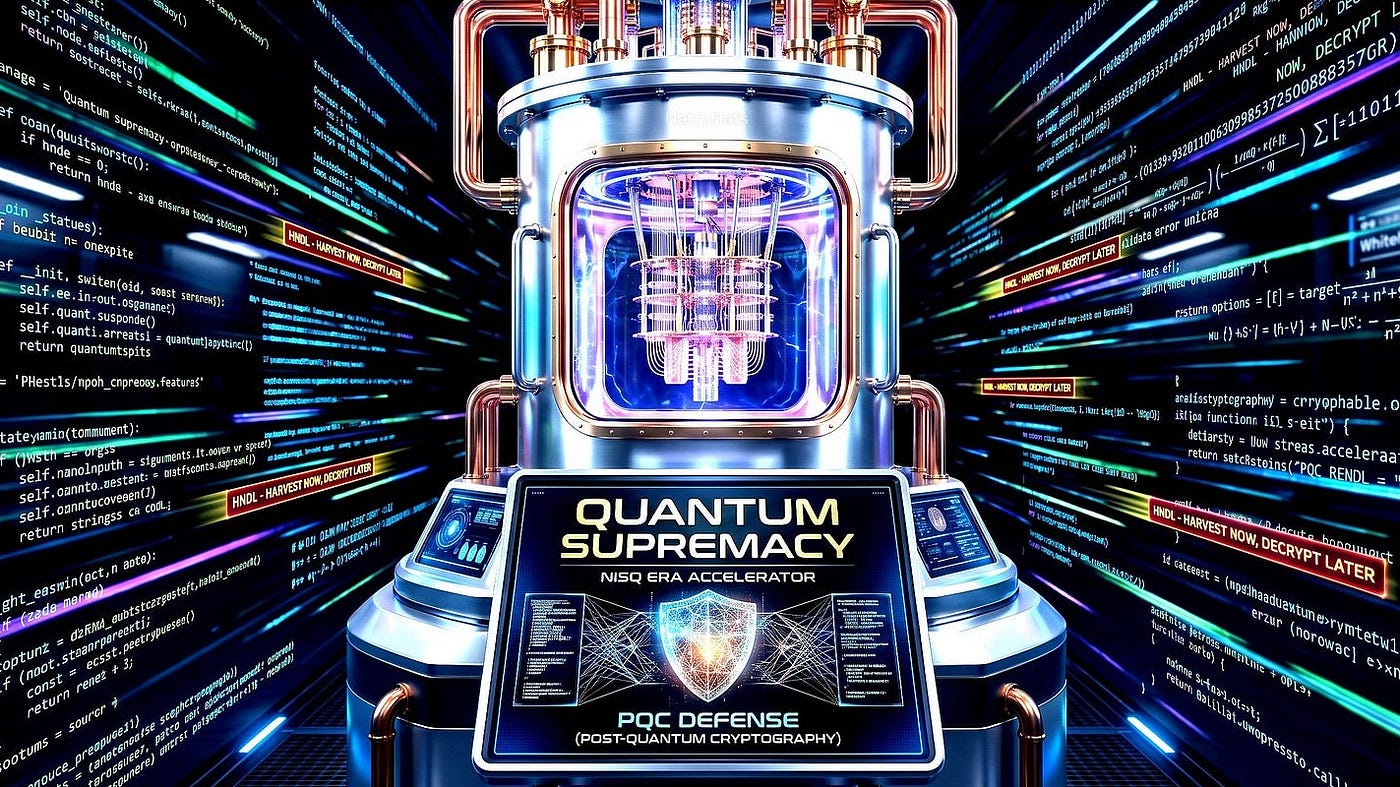
The Quantum Apocalypse is coming…but not in the way you think

  If you’ve spent any time scrolling through tech news lately, you’ve probably seen the headlines. Quantum computing is usually portrayed as...