If you’ve spent any time scrolling through tech news lately, you’ve probably seen the headlines. Quantum computing is usually portrayed as this mystical, glowing monolith that’s going to solve world hunger on Tuesday and break all of human privacy by Wednesday. It’s the ultimate deus ex machina of the silicon world. But here’s the thing, we’re currently in 2026 and the Quantum Apocalypse hasn’t quite arrived. At least not in the way the sci-fi movies promised.
Instead, we’ve landed in a bit of a weird hybrid era. It’s less like replacing your laptop with a warp drive and more like adding a very temperamental, sub-zero turbocharger to a classic car. We’re living in the age of NISQ (Noisy Intermediate-Scale Quantum), where the hardware is finally powerful enough to do things classical computers find impossible, but also noisy enough to make a lot of mistakes. Think of it as a genius mathematician who can calculate the secrets of the universe but occasionally forgets how to carry the one because someone in the next room sneezed.
We Aren’t Replacing PCs (Yet)
Press enter or click to view image in full size
Let’s clear something up right away. Your next MacBook isn’t going to have a quantum chip. I know, I’m disappointed too. But the reason is purely physical. Despite the massive 2026 milestones from heavyweights like IBM and Google, these chips are still incredibly high-maintenance divas. They have to be kept at temperatures colder than outer space just to keep their qubits from decohering, which is basically quantum-speak for getting distracted by a stray vibration and losing all their data.
In 2026, we’ve realized that quantum computers aren’t general-purpose machines. They are the world’s most expensive specialized co-processors. We’re seeing a hybrid model take over where Nvidia is using AI to accelerate quantum error correction, helping these noisy chips finally become useful. In fields like drug discovery, researchers use their regular classical computers to handle the data management, then offload the nightmare-level molecular simulations to a quantum chip. It’s a tag-team effort. We’re finally seeing these accelerators tackle things like finding new catalysts for carbon capture. Tasks where close enough is actually a massive breakthrough, even if the machine still makes the occasional quantum hiccup.
Measuring Success Beyond Just Qubits
Press enter or click to view image in full size
For years, we were obsessed with qubit counts. It was the megahertz race of the 2020s. But in 2026, the industry has shifted its focus to a much more honest metric. QuOps (error-free Quantum Operations). As the experts at Riverlane have pointed out, a million noisy qubits are useless if they can’t finish a calculation before collapsing.
This shift is huge because it means we’ve stopped trying to build a magic box and started doing real engineering. We are now seeing the first Fault-Tolerant Quantum Computers (FTQCs) emerge. Small systems that use error-correcting codes to protect information. It’s the difference between a paper plane and a Wright brothers’ glider. It’s not a 747 yet, but it’s staying in the air. Companies are now focusing on a generational roadmap (KiloQuOp, MegaQuOp, and eventually GigaQuOp) giving us a clear path to when these machines will actually outperform a supercomputer on a consistent basis, starting with MegaQuOp systems for specialized tasks and moving toward GigaQuOp for broader commercial applications.
The Ghost in the Machine
Press enter or click to view image in full size
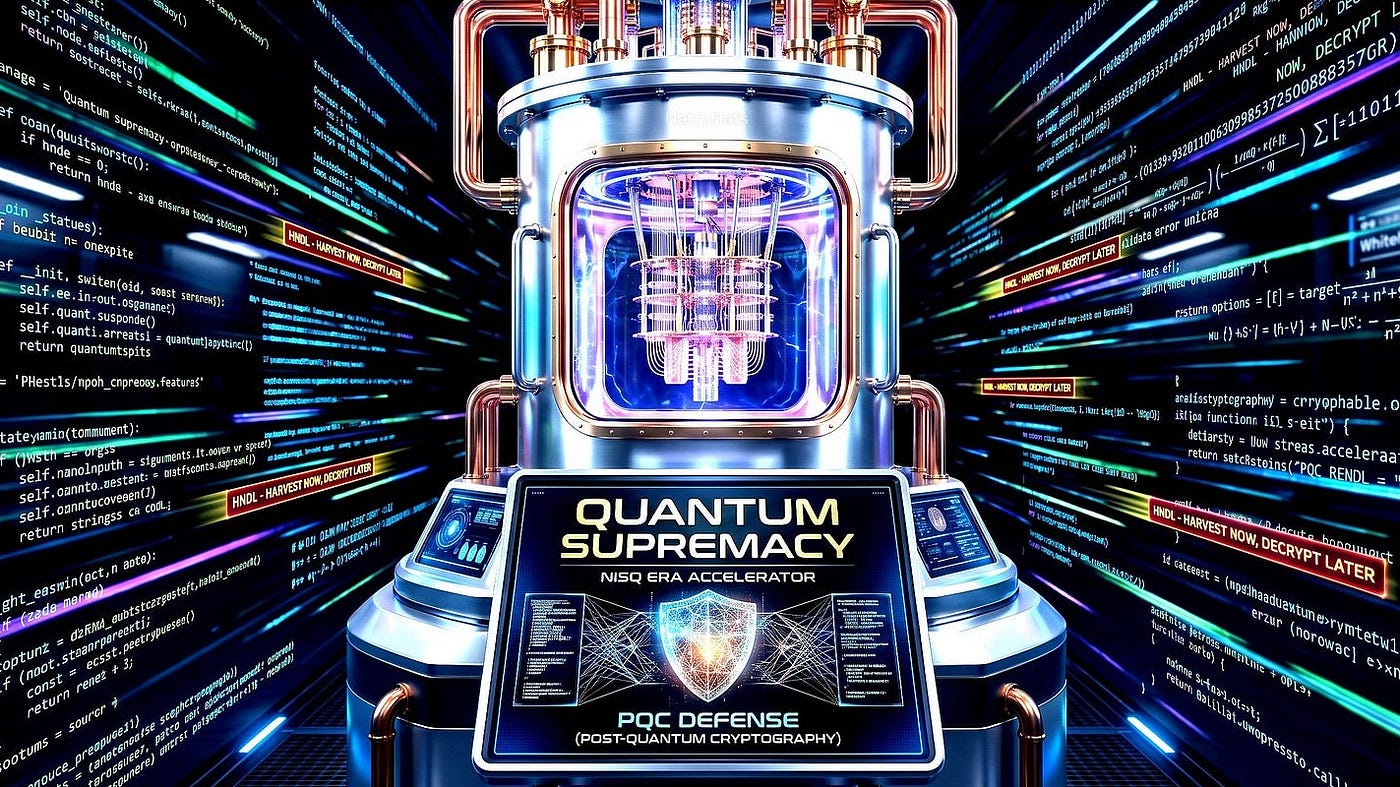
Now, let’s talk about the part that keeps security experts awake at night. You might think, “If quantum computers are still noisy and error-prone, my encrypted emails are safe, right?” Well, yes, for today. But there’s a massive but coming. Enter the HNDL strategy, Harvest Now, Decrypt Later. This isn’t just a spy thriller plot either, it’s an active intelligence strategy being used right now.
Imagine a bad actor vacuuming up terabytes of your encrypted data today (bank records, government cables, trade secrets) and just… sitting on it. They can’t read it yet, but they’re betting that in 10 to 15 years, a stable quantum computer will exist that can run Shor’s Algorithm. Once that happens, they can crack open those old files like a digital time capsule. According to recent expert surveys, there is a meaningful probability of a cryptographically relevant quantum computer appearing by the mid-2030s. If your data needs to stay secret for decades, it’s effectively sitting on a shelf with a countdown timer attached to it.
The Death of RSA and the Rise of the Shield
Press enter or click to view image in full size
We’ve reached the point where the end of encryption isn’t a math theory anymore, it’s a massive logistics headache. Our current asymmetric encryption (the stuff that keeps the green padlock on your browser) is built on the assumption that factoring giant prime numbers is hard. To a classical computer, it’s impossible. To a stable quantum computer, it’s a light snack.
The good news? The counter-offensive is finally here. 2026 is a major turning point because the wait and see approach is officially dead. Agencies like CISA are now providing explicit guidance for transitioning to Post-Quantum Cryptography (PQC), specifically prioritizing the ML-KEM standard for secure data exchange. These are new, lattice-based math standards designed to be quantum-resistant. The big buzzword right now is crypto-agility. Companies are realizing they can’t just set their encryption and forget it for twenty years. They need systems that can swap out algorithms as easily as you’d update an app on your phone. It’s a race against time really. Can we re-encrypt the world’s most sensitive infrastructure before the harvest now crowd gets their hands on a stable QPU?
More Than Just Fast Downloads
Press enter or click to view image in full size
While everyone is worried about breaking codes, there’s a whole other side of the story that’s actually pretty hopeful, the Quantum Internet. In 2026, we aren’t just building computers, we’re starting to build the networks that connect them. This isn’t about watching 8K Netflix, it’s about Quantum Key Distribution (QKD).
The Quantum Internet allows us to send information in a way that is physically impossible to eavesdrop on without being detected. Because of the laws of physics, if someone tries to observe a quantum signal in transit, the signal changes, and the sender and receiver instantly know they’ve been compromised. We are seeing testbeds for this technology popping up in places like Maryland and India, laying the groundwork for a future where communication isn’t just encrypted by math, but protected by the fundamental laws of the universe.
The Fault-Tolerant Horizon
Press enter or click to view image in full size
So, where does that leave us? Honestly, we’re in the vacuum tube era of quantum computing. It’s messy, it’s expensive, it requires a small army of Ph.D.s to keep it running, and it’s prone to breaking if you look at it wrong. But the transition from NISQ to true fault-tolerant computing is the next big milestone. We’re moving away from just more qubits and focusing on better qubits that can correct their own mistakes.
The next few years won’t be about a single eureka moment that changes the world overnight. Instead, it’ll be a slow, steady grind of improving error correction and scaling up. The magical super-processor is still on the horizon, but the practical quantum accelerator is already in the room. The real question for the rest of us isn’t whether quantum will arrive, it’s whether we’ll have our digital shields up in time to meet it. It’s a weird, exciting, and slightly terrifying time to be online, but hey, that’s just another Tuesday in tech I guess.
Thanks for reading everyone! Visit my site to learn more about me and explore what I’m building at Learn With Hatty. I hope everyone has a great day and as I always say, stay curious and keep learning.
The cloud just failed one of its biggest unspoken promises of no matter what happens, we’ll stay up. On March 1, 2026, anAWS data center in the UAE was hit by drones during Iranian strikes, causing sparks, a fire, and a full power cut to part of the facility. For a few hours, banks, apps, and services that treated “the cloud” as an abstract utility ran into a more old‑school reality. Your servers live in a building, and buildings live in geopolitics.
At the same time, Microsoft has been rolling out the opposite of the old “always online” cloud dream. Sovereign private clouds and fully disconnected AI environments that keep running even when the wider internet or region gets messy. Put those two together, and you get a very 2026 question. What does resilience look like when your AI, your data, and your infrastructure are now targets in a hot conflict?
When “Objects” Hit The Data Center
Press enter or click to view image in full size
On March 1, 2026, AWS reported that “objects” had hit one of its data centers in the UAE, triggering a fire and forcing authorities to cut power to a cluster of facilities in its me-central-1 region. Follow‑up reporting confirmed this was part of a wider Iranian barrage of drones and missiles against Gulf states, launched in retaliation for earlier US and Israeli strikes.
Technical write‑ups from data center watchers note that a full availability zone in AWS’s UAE region went down, with both grid and backup generators shut off while firefighters worked. Local business outlets reported that the fire “knocked cloud services offline across parts of the UAE,” and AWS told customers that recovery would be “prolonged” because of physical damage to power and networking gear. This wasn’t a misconfigured router, it was literal infrastructure getting caught in a shooting war.
What Actually Broke When The Cloud Broke
Press enter or click to view image in full size
The blast radius wasn’t global, but it was very real. Reuters reported that AWS’s UAE and Bahrain data centers suffered structural damage, power loss, and water damage from fire suppression, and that the company warned customers to expect a slow recovery. At the same time, the AWS status dashboard showed multiple core services in the affected zone (EC2, networking, storage, and managed databases) experiencing serious disruption.
One detailed recap notes that “roughly a dozen core cloud services” in the UAE region were impacted and that AWS advised customers to back up data and shift workloads to unaffected regions. Abu Dhabi Commercial Bank publicly acknowledged that its platforms and mobile app were unavailable due to a “region‑wide IT disruption,” widely linked by analysts to the AWS outage even though the bank didn’t name it directly. In short, if you were tightly pinned to that zone, your “high availability” turned into “we’ll be back when the fire department is done.”
From “Always Connected” Cloud To Disconnected Sovereign AI
Press enter or click to view image in full size
While AWS was dealing with a war‑driven outage, Microsoft was busy announcing how to keep clouds running in places that expect connectivity to be unreliable. In February 2026, Microsoft unveiled new capabilities for its Microsoft Sovereign Cloud. Azure Local with disconnected operations, Microsoft 365 Local (disconnected), and Foundry Local for large AI models. The pitch is simple. Governments, public institutions, and regulated industries can run infrastructure, productivity apps, and advanced AI in fully sovereign environments that don’t need any external internet connection.
Microsoft’s own messaging leans on outside numbers too. In a March 2026 briefing, they cited a Gartner estimate that worldwide sovereign cloud spending will grow by about 35.6% this year, driven by regulators and customers who want strict control over where data lives and who can touch it. Their blog post sums up the mindset I think. “trust is built on confidence that data stays protected, controls are enforceable and operations can continue under real‑world conditions.”
To make that practical, Microsoft’s Sovereign Private Cloud ties Azure Local, Microsoft 365 Local, and Foundry Local into a single stack that can run connected, intermittently connected, or fully disconnected. The idea is that customers can standardize governance and operations across that spectrum instead of bolting together three different worlds. When a regulator or security team says “this workload must keep running even if the public internet is gone,” there’s now a product SKU for that.
AI Is Not Just Software, It’s Infrastructure You Can Lose
Press enter or click to view image in full size
The 2026 twist is that we’re not just talking about virtual machines and storage; we’re talking about AI agents and copilots that organizations are wiring into everything. Microsoft describes Foundry Local as a way for customers with “highly secure environments” to run large, multimodal models directly inside their sovereign private cloud, with local APIs and inference that never hit the public internet. That covers use cases like document search, analytics, code assistance, and domain‑specific copilots that need to live behind strict walls.
The AWS UAE incident is a reminder that when those AI capabilities live only as services in a specific public region, they inherit that region’s physical and geopolitical risks. If a strike or power cut can take out your primary AI region, then your “AI‑powered operations” can be degraded overnight. Sovereign and disconnected AI stacks flip that dependency around. Critical models and agents live where your data and hardware live, and public cloud AI becomes an optional accelerator instead of a single point of failure.
What “Resilience” Actually Means Now
Press enter or click to view image in full size
So what does resilience look like after a data center fire in a war zone and a wave of sovereign cloud launches? First, multi‑AZ inside a single metro region is clearly not enough for truly critical workloads if one physical event can bring an entire zone down. Second, if regulation or latency pins you to a specific geography, you need a tested failover path (another region, another cloud, or a sovereign installation) that doesn’t share the same physical and political blast radius. Third, treating one hyperscaler as a single, magical black box is no longer a serious strategy. You have to know where your stuff lives and how it fails.
That’s why you’re seeing a mix emerge. Sovereign private clouds for crown‑jewel workloads, hybrid and multi‑cloud patterns for less sensitive systems, and more serious thinking about where AI and identity should live by default. It’s less about abandoning the public cloud and more about finally admitting it’s just very fancy infrastructure, not a force field. Once you accept that, “sovereign AI” stops sounding like a buzzword and starts looking like basic risk management.
Personal Thoughts
Now, to be honest, I think we all need to start looking much more seriously at decentralized options like Iagon. If geopolitical risk keeps escalating, relying only on centralized cloud connectivity is going to hurt. We need infrastructure that is genuinely decentralized, designed so no single building, provider, or government can just switch it off.
What do you think? Is it time we start doing things differently and move more of our critical workloads off traditional cloud silos and onto resilient, decentralized rails?
Thanks for reading everyone! I hope you enjoyed the article. Please remember to always do your own research. Stay curious and keep learning!
Check out my website to find all of my content and the different websites I’m building.
In a world flooded with information and a constant thirst for knowledge, the saying “knowledge is power” has taken on a whole new meaning. Nowadays, it’s pretty common to use information as a strong weapon against both real and imagined enemies. This idea isn’t exactly new — it goes way back in history. But what makes our time different is the crazy explosion of information that’s taken over our lives. With so much data out there, it’s getting harder to figure out what’s true and what’s not.
As we navigate this complicated world of information battles, we’re entering a new era that’s even tougher to handle. The rise of artificial intelligence (AI) is making things crazier, adding a level of sophistication to how facts are twisted and lies are spread. We’re at a crucial point in history where this information weapon has become an even bigger threat, shaking up society and messing with the truth itself.
This article is a journey through the history of information battles, from ancient tricks to today’s digital clashes. We’re going to break down the dangers of having too much information and how it messes with our heads. But the big deal here is AI in this information fight. The goal isn’t just to point out the problems — I also want to look at possible fixes. In this information age, being able to tell what’s true and what’s not, and using knowledge responsibly, might be the most powerful weapon we’ve got.
As we dig deeper into this, let’s remember that the battlefield of the 21st century isn’t about borders or traditional weapons. It’s a war of stories, a fight of ideas, and a competition for the thoughts and feelings of people worldwide. Welcome to the era of “Information Warfare.”
The Evolution of Information Warfare
Throughout human history, using information as a weapon has played a major role, in influencing the outcomes of wars, revolutions, and the destiny of nations. As we take a trip through history, digging into the evolution of information warfare, we discover its origins in the murkiest corners of human conflict.
Before we dive into its history, let’s get a clear picture of what information warfare is all about. At its core, it’s using information strategically to get ahead, shape perceptions, or achieve specific goals. This involves a bunch of tactics, from messing with people’s heads to cyber spying.
What is information warfare?
Information warfare is an operation conducted in order to gain an information advantage over the opponent. It consists in controlling one’s own information space, protecting access to one’s own information, while acquiring and using the opponent’s information, destroying their information systems and disrupting the information flow. Information warfare is not a new phenomenon, yet it contains innovative elements as the effect of technological development, which results in information being disseminated faster and on a larger scale. — Source
The roots of information warfare go way back to ancient times. One of the earliest instances is the whole “Trojan Horse” thing in Greek mythology. The Greeks pulled off a sneaky move, taking advantage of the Trojans’ trust. It showed how tricks and spreading false info could help achieve big goals.
Fast forward to the Renaissance, and the printing press kicked off a new era of information sharing. Martin Luther spreading the Ninety-Five Theses using the printing press stirred up the Protestant Reformation, challenging the Catholic Church’s authority and showing how mass communication could be a game-changer.
Information Warfare was also used in WW2 through posters, radios, and movies. We have been dealing with information warfare for centuries.
To meet the government’s objectives the OWI (Office of War Information) used common propaganda tools (posters, radio, movies, etc.) and specific types of propaganda. The most common types used were fear, the bandwagon, name-calling, euphemism, glittering generalities, transfer, and the testimonial. — Source
Fast forward to today, when we are dealing with a flow of information we can barely keep up with.
Nowadays, we’re dealing with misinformation like never before. Did you know that a whopping 85% of the world’s population owns a smartphone? Crazy, right? I get that the pic I posted above might not matter much to the average person, but it just goes to show how quickly false information can spread and how easy it has become to create and spread. It messes with people’s heads, causing confusion and making everyone wonder what’s actually true and what’s just made up.
The Digital Age
Jump to today, and we’re in a whole new league when it comes to information warfare. The internet and digital tech have completely changed the game. With the world super connected, spreading both real and fake info has become a global thing. The 21st century has turned information warfare into a powerful force in global affairs, going beyond national borders.
The UK’s vote to leave the European Union, or Brexit, in 2016 is considered another example of information warfare, where Russia saw an opportunity to weaken the EU. While Russia’s level of interference is still a matter of debate, many suggest it was significant. For example, a sample of 1.5 million tweets related to Brexit showed that 30% of the tweets came from just 1% of accounts. — Source
In this digital age, messing with information through disinformation campaigns, cyberattacks, and social media tricks has become the norm for countries, groups, and even individuals. Quick info spreading, whether true or not, can mess with elections, stir up social unrest, and make people lose trust in institutions.
As we step further into the digital world, it’s important to know that information warfare isn’t just something for spy agencies and governments. It’s become a thing for everyday people and groups with all sorts of motives, making this a tricky and high-stakes game.
In the next parts of this article, we’ll look into the challenges of dealing with too much information, the rise of AI, and the big impacts of these changes. The history of information warfare gives us a background to understand what’s going on in our world today.
The Age of Information Overload
In the 21st century, our lives are filled with information. From the moment we wake up to when we call it a night, we’re hit with a constant flow of data. It’s a bit of a mixed bag because while info can open our eyes, it also has the potential to overwhelm, confuse, and even trick us.
Info Overload
Never before have we had so much info at our fingertips. Thanks to the internet, smartphones, and social media, we’re swimming in a sea of information. News, opinions, facts, and made-up stuff keep pouring through the digital channels that are everywhere in our lives.
TikTok — 34 million videos uploaded a day.
Facebook — 4.75 billion items are shared by Facebook users each day.
YouTube — Around 3.7m new videos are uploaded to YouTube every day.
The amount of data is mind-blowing. Every minute, millions of tweets, hours of videos on YouTube, and a ton of articles, blogs, and status updates flood the web. In this time, knowledge isn’t something limited, it’s like this never-ending sea, and we’re just small boats trying to navigate it.
Figuring out the Truth In this flood of info, there’s a big challenge. How do we know what’s true and what’s made up? Misinformation and lies thrive here, often pretending to be real news or expert opinions. Being able to look critically at sources, double-checking info, and having good judgment is super important for anyone living in the modern world.
Our minds aren’t really built to handle all this info every day. Biases, like believing things that fit with what we already think, can make us accept info that supports our views and ignore stuff that goes against them. In this kind of situation, false info can stick around and cause problems.
Mental Effects
Getting hit with all this info, especially when it’s conflicting or over-the-top, messes with our minds. Too much info can tire us out, mess with our thinking, and make our attention spans shorter. The stress of dealing with all this info can even mess with our mental health, causing anxiety and info-related issues.
Plus, being bombarded with super emotional content all the time can split up societies. People end up sticking to sources that agree with them and avoiding anything that challenges their views. This creates a sort of bubble where communities split apart and it’s hard to find common ground in a time when we’re drowning in info.
In the next part, we’ll look into how artificial intelligence adds to this already tricky situation, making info overload even more challenging and dangerous. As we navigate this crazy sea of data, being able to think critically and understand media has never been more important. It’s like the only anchor that can keep us steady in the wild waters of the digital age.
AI and the Escalation of Information Warfare
As we look ahead into the future, there’s this tech thing that’s shaping up to change the game in information warfare, artificial intelligence. AI is like a powerhouse that can handle a ton of data, come up with convincing stories, and mess with content. It’s got some cool opportunities and potential, but it’s also bringing some serious risks to the world of information warfare.
AI’s Roll in Information Warfare
Artificial intelligence has become a big deal in the world of information warfare. It’s awesome at analyzing massive amounts of data, spotting patterns, and guessing what people might do. AI-powered algorithms are behind recommendation engines and platforms that spread content, quietly shaping the info scene without users even realizing it.
Nearly 50 news websites are ‘AI-generated’, a study says. Would I be able to tell?Source
One pretty freaky thing about AI in information warfare is its ability to automatically create and spread fake info. Take deepfake tech, for example — it can make super convincing audio and video that messes with our ability to tell what’s real and what’s fake. As this AI-made content gets better, the chances of fake news spreading like wildfire get way higher.
Deepfake Tech
A Whole New World Thanks to AI, deepfake tech has hit a level where it can slap the faces and voices of big shots onto made-up situations that look real. This opens up serious risks, like creating fake videos of political leaders saying crazy stuff or simulating business bigwigs giving out false financial info. The fallout from these fakes is massive, wrecking trust in real sources and causing chaos in the info world.
Deepfakes go beyond just messing with politics and money. People’s lives and relationships can get messed up big time by using AI to create fake content. The line between what’s real and what’s made up is getting blurred, putting reality itself in jeopardy.
AI-Made Content
Pumping Out Misinformation AI doesn’t stop at deepfakes, it’s also into making all kinds of content. AI algorithms can whip up articles, tweets, and even academic papers that sound like they’re written by humans. This lets AI flood the scene with loads of fake info, making it hard for fact-checkers to keep up and saturating info channels. AI can be used for good and bad. It just depends on how you use it. It is a powerful weapon for good and bad. The point is that you can never know and the technology is only getting stronger. Make sure to always do your research and make sure the information you are receiving is true.
As AI gets fancier, it can fine-tune its fake info for specific groups, playing on individual beliefs and biases. This super-targeted fake news is a serious threat to keeping society together, pushing communities apart, and messing with what we all agree is true.
In the next sections, we’ll dig into what happens when information warfare meets AI, looking at how it messes with society and politics, raises national security worries, and wrecks trust. With AI stepping up in this game, we need to rethink how we fight fake news and commit to developing AI in a way that’s ethical and responsible. In a world where tech can make its own reality, keeping the truth intact is a must for keeping society standing strong.
The Consequences of Information Warfare
In the ongoing battle of information warfare, the fallout goes way beyond the digital scene. Playing with information strategically can reshape politics, put national security at risk, and, sneakily, chip away at the trust that holds our societies together.
Impact on Society and Politics
The impact of information warfare on how we live and do politics is huge. In the digital age, fake news campaigns can hit millions in just seconds, changing public opinions and driving wedges between different groups. Social media, meant to bring people together, has accidentally become a way to spread fake news and divide people.
Elections are especially vulnerable to information warfare. Foreign players, local political movers, and interest groups use the quick-spreading nature of social media to push propaganda, create chaos, and mess with how people feel about voting. Elections, big decisions, and political stuff all around the world have been shaped by spreading lies and stirring up conflicts.
National Security Worries
Information warfare is a big threat to national security. Besides messing with politics, it can directly target important stuff like infrastructure, government stuff, and military actions. Cyberattacks and spreading lies, especially when backed by a country, can mess up essential services, leak sensitive info, and even start conflicts.
Turning information into a weapon can make global tensions worse, leading to big diplomatic problems or even wars. In a world where everything is connected, the line between regular fighting and information warfare gets blurry. Countries need to put their money into cyber defenses and come up with good plans to deal with these info threats.
Trust Going Downhill
Maybe the sneakiest thing about information warfare is how it slowly kills trust in societies. As fake news spreads, people start doubting news sources, big institutions, and even each other. The whole “fake news” thing makes it feel like everything’s up in the air, and telling what’s true from what’s a lie becomes a real challenge.
In the next part, we’ll check out some ways to fight information warfare, like getting better at understanding media and using tech solutions. Facing the big fallout of this digital battle, it’s pretty clear that keeping the truth safe, making sure our countries are secure, and keeping society together all depend on us navigating the tricky waters of information warfare in a smart way and as a team.
Combating Information Warfare
As we face the challenges of information warfare, it’s crucial to come up with smart strategies to lessen its impact. Fighting against fake news and misleading info needs a mix of education, tech solutions, and ethical thinking.
Media Literacy
The best way to stand against information warfare is by boosting media literacy. Giving people the skills to check info sources, spot biases, and judge if something is trustworthy is key. Schools, from the early years to college, should make media literacy part of what they teach.
Media literacy efforts should also reach adults and folks who might be more at risk. Public campaigns can help everyone become smarter about the info they come across, making it harder for manipulators to mess with them.
Tech Fixes
Using AI Wisely Even though AI has helped spread fake info, it also has the potential to fix things. AI-powered systems can spot and flag shady content, figure out if videos or pics are deepfakes, and check how credible news sources are.
Social media and tech companies need to put money into AI tools that fight fake news on their platforms. These tools don’t just take down harmful content, they also give users clear info about where stuff comes from and how true it is.
Rules and Ethics
Dealing with information warfare through rules is tricky. We’ve got to strike a balance between protecting free speech and stopping bad stuff. Governments, tech companies, and groups in society need to work together to make rules that are fair.
Being clear about why content is taken down and giving people a way to appeal decisions is super important for social media platforms. Governments can make laws that hold platforms responsible if they don’t do enough to stop fake info that puts people at risk.
Global Team Effort
Information warfare doesn’t care about borders, so countries need to work together. Sharing info about threats, fighting against fake info campaigns, and setting standards for fair behavior online is crucial. I know at the moment the world is divided but I am hoping one day we can all work together to better ourselves, our planet, and our children's future.
Global plans to fight information warfare can show a strong stance against bad actors. Diplomacy should aim to make agreements about how we use the internet, kinda like how we did with arms control in the past.
Encouraging Ethical AI
The folks who create AI have a big job in this fight. They need to put ethics first, making systems that care about truth, are clear about how they work, and can be held accountable. While AI can make deepfakes, there should also be tech that spots and proves if something is real.
Our ability to keep the truth safe, protect society, and stick to democratic values all depend on everyone working together to fight against turning information into a weapon in the digital age.
What exactly is the truth though? Do you know? How long does it take for information to become so hard to decipher you do not know what is real?
In the end, it all comes down to sticking to the truth — it’s the foundation of our society. If we stay focused on finding the truth, no matter our political or cultural differences, we can beat deception. Nowadays, the battlefield isn’t about physical weapons but about hearts and minds, the reliability of our information, and the core of our democratic way of life. If we protect the truth, use technology wisely, and build global resilience against misinformation, we’ll come out of this digital mess even stronger and more united.
The future is ours to shape, and it begins with the choices we make today. The information you share can change the thoughts of many so make sure that the information is true and you have the facts to back it up.
I hope you enjoyed this article. I know it is not about my favorite topic Cryptocurrency, but sometimes I think it is nice to spread your wings.
Check out the list below for all of my favorite ways to earn online.
Blogging, gaming, writing, reading, listening, the sky is the limit when earning Crypto. Find the full list on my website!
Faucets and PTC (Point to Click) Website/Apps
FaucetPay — FaucetPay is a microwallet that connects you to multiple earning websites and allows you to deal in microtransactions without having to pay high gas fees. Click here to learn more about this earning opportunity.
CoinPayz — Earn multiple different types of Crypto
FaucetCrypto — Earn over 21 different types of Crypto. Sometimes you have to wait for the withdraw wallets to get filled but it is a
Social Blockchain
Tangled — Tangled is a social network that allows you to earn Millix. You can also earn Millix by downloading and running the Tangled browser. The browser runs as a node for the network and allows your computer to start earning you passive income. — MLX
LoftyAI — Real Estate that runs on the Algorand Blockchain. Buy fractions of Real Estate and earn Daily from your investment.
Atlas Earth — or use 0GNQNB — Earn a passive income from digital land! Earn land either by buying it or watching ads!
Blogging for Crypto!
Medium — You do not earn Crypto from Medium but you can use this amazing blogging platform to get your content out there. After 100 followers you can start earning money. It takes a little time but it is worth the effort.


.jpg)










 Image by
