Showing posts with label AI content creation. Show all posts

Sunday, April 19, 2026

The Quantum Apocalypse is coming…but not in the way you think


If you’ve spent any time scrolling through tech news lately, you’ve probably seen the headlines. Quantum computing is usually portrayed as this mystical, glowing monolith that’s going to solve world hunger on Tuesday and break all of human privacy by Wednesday. It’s the ultimate deus ex machina of the silicon world. But here’s the thing, we’re currently in 2026 and the Quantum Apocalypse hasn’t quite arrived. At least not in the way the sci-fi movies promised.

Instead, we’ve landed in a bit of a weird hybrid era. It’s less like replacing your laptop with a warp drive and more like adding a very temperamental, sub-zero turbocharger to a classic car. We’re living in the age of NISQ (Noisy Intermediate-Scale Quantum), where the hardware is finally powerful enough to do things classical computers find impossible, but also noisy enough to make a lot of mistakes. Think of it as a genius mathematician who can calculate the secrets of the universe but occasionally forgets how to carry the one because someone in the next room sneezed.

We Aren’t Replacing PCs (Yet)

Press enter or click to view image in full size

Let’s clear something up right away. Your next MacBook isn’t going to have a quantum chip. I know, I’m disappointed too. But the reason is purely physical. Despite the massive 2026 milestones from heavyweights like, these chips are still incredibly high-maintenance divas. They have to be kept at temperatures colder than outer space just to keep their qubits from decohering, which is basically quantum-speak for getting distracted by a stray vibration and losing all their data.

In 2026, we’ve realized that quantum computers aren’t general-purpose machines. They are the world’s most expensive specialized co-processors. We’re seeing a hybrid model take over where, helping these noisy chips finally become useful. In fields like drug discovery, researchers use their regular classical computers to handle the data management, then offload the nightmare-level molecular simulations to a quantum chip. It’s a tag-team effort. We’re finally seeing these accelerators tackle things like finding new catalysts for carbon capture. Tasks where close enough is actually a massive breakthrough, even if the machine still makes the occasional quantum hiccup.

Measuring Success Beyond Just Qubits

Press enter or click to view image in full size

For years, we were obsessed with qubit counts. It was the megahertz race of the 2020s. But in 2026, the industry has shifted its focus to a much more honest metric. QuOps (error-free Quantum Operations). As the experts at, a million noisy qubits are useless if they can’t finish a calculation before collapsing.

This shift is huge because it means we’ve stopped trying to build a magic box and started doing real engineering. We are now seeing the first Fault-Tolerant Quantum Computers (FTQCs) emerge. Small systems that use error-correcting codes to protect information. It’s the difference between a paper plane and a Wright brothers’ glider. It’s not a 747 yet, but it’s staying in the air. Companies are now focusing on a (KiloQuOp, MegaQuOp, and eventually GigaQuOp) giving us a clear path to when these machines will actually outperform a supercomputer on a consistent basis, starting with MegaQuOp systems for specialized tasks and moving toward GigaQuOp for broader commercial applications.

The Ghost in the Machine

Press enter or click to view image in full size

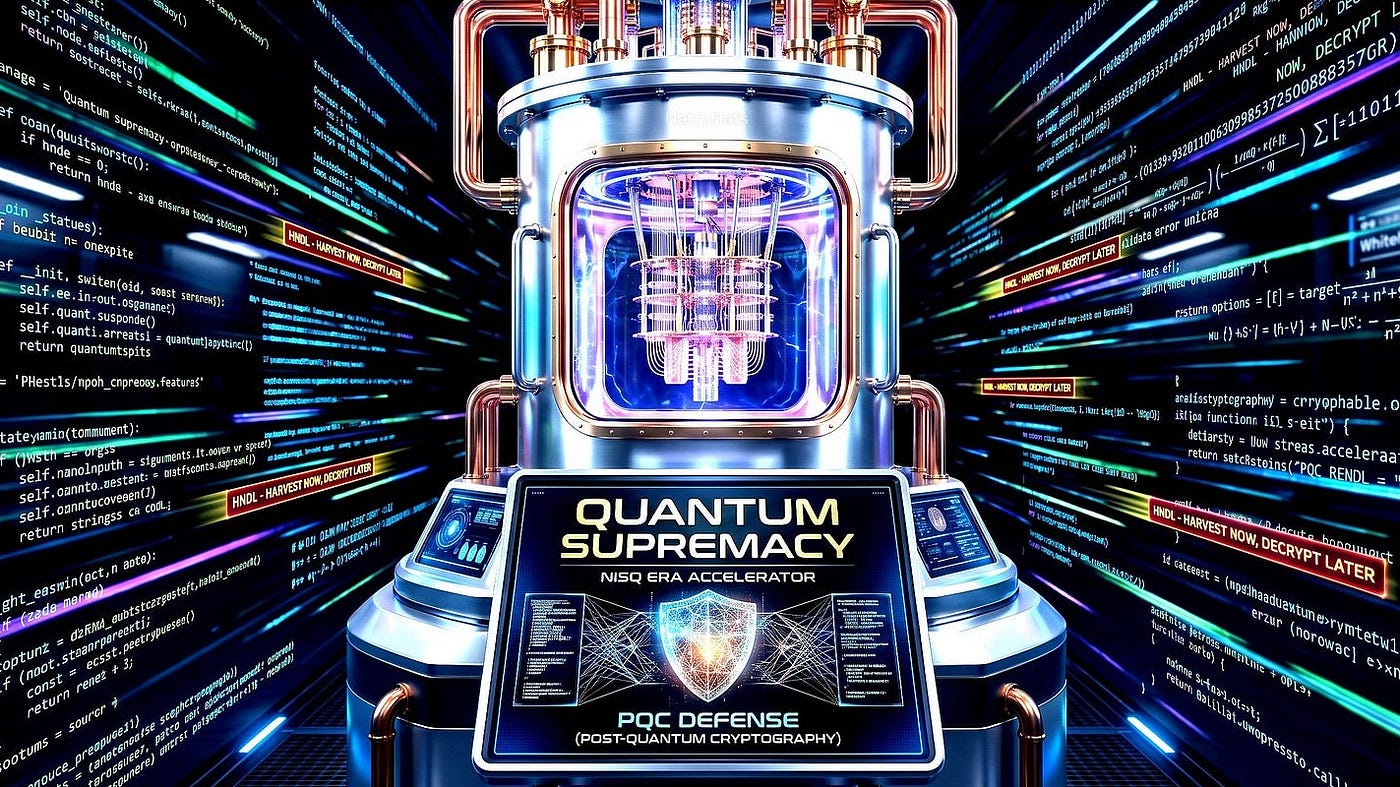
Now, let’s talk about the part that keeps security experts awake at night. You might think, “If quantum computers are still noisy and error-prone, my encrypted emails are safe, right?” Well, yes, for today. But there’s a massive but coming. Enter the HNDL strategy,. This isn’t just a spy thriller plot either, it’s an active intelligence strategy being used right now.

Imagine a bad actor vacuuming up terabytes of your encrypted data today (bank records, government cables, trade secrets) and just… sitting on it. They can’t read it yet, but they’re betting that in 10 to 15 years, a stable quantum computer will exist that can run Shor’s Algorithm. Once that happens, they can crack open those old files like a digital time capsule. According to recent expert surveys, there is a appearing by the mid-2030s. If your data needs to stay secret for decades, it’s effectively sitting on a shelf with a countdown timer attached to it.

The Death of RSA and the Rise of the Shield

Press enter or click to view image in full size

We’ve reached the point where the end of encryption isn’t a math theory anymore, it’s a massive logistics headache. Our current asymmetric encryption (the stuff that keeps the green padlock on your browser) is built on the assumption that factoring giant prime numbers is hard. To a classical computer, it’s impossible. To a stable quantum computer, it’s a light snack.

The good news? The counter-offensive is finally here. 2026 is a major turning point because the wait and see approach is officially dead.  are now providing explicit guidance for transitioning to Post-Quantum Cryptography (PQC), specifically prioritizing the  standard for secure data exchange. These are new, lattice-based math standards designed to be quantum-resistant. The big buzzword right now is crypto-agility. Companies are realizing they can’t just set their encryption and forget it for twenty years. They need systems that can swap out algorithms as easily as you’d update an app on your phone. It’s a race against time really. Can we re-encrypt the world’s most sensitive infrastructure before the harvest now crowd gets their hands on a stable QPU?

More Than Just Fast Downloads

Press enter or click to view image in full size

While everyone is worried about breaking codes, there’s a whole other side of the story that’s actually pretty hopeful, the Quantum Internet. In 2026, we aren’t just building computers, we’re starting to build the. This isn’t about watching 8K Netflix, it’s about Quantum Key Distribution (QKD).

The Quantum Internet allows us to send information in a way that is physically impossible to eavesdrop on without being detected. Because of the laws of physics, if someone tries to observe a quantum signal in transit, the signal changes, and the sender and receiver instantly know they’ve been compromised. We are seeing popping up in places like Maryland and India, laying the groundwork for a future where communication isn’t just encrypted by math, but protected by the fundamental laws of the universe.

The Fault-Tolerant Horizon

Press enter or click to view image in full size

So, where does that leave us? Honestly, we’re in the vacuum tube era of quantum computing. It’s messy, it’s expensive, it requires a small army of Ph.D.s to keep it running, and it’s prone to breaking if you look at it wrong. But the transition from NISQ to true fault-tolerant computing is the next big milestone. We’re moving away from just more qubits and focusing on better qubits that can correct their own mistakes.

The next few years won’t be about a single eureka moment that changes the world overnight. Instead, it’ll be a slow, steady grind of improving error correction and scaling up. The magical super-processor is still on the horizon, but the practical quantum accelerator is already in the room. The real question for the rest of us isn’t whether quantum will arrive, it’s whether we’ll have our digital shields up in time to meet it. It’s a weird, exciting, and slightly terrifying time to be online, but hey, that’s just another Tuesday in tech I guess.

0*MzgqLSgUtfVvVRa2.gif

Thanks for reading everyone! Visit my site to learn more about me and explore what I’m building at  I hope everyone has a great day and as I always say, stay curious and keep learning.

Original article on 

Thursday, March 26, 2026

AI Is Everywhere, and It's Exhausting


I remember when AI felt like a cool toy. You opened up a chatbot, played around with a few prompts, maybe had it write a dumb rap about your dog or even a funny picture, and that was it. Now it feels like every app, every job, every device is quietly whispering, “Have you tried doing that with AI?” It went from fun sidekick to clingy coworker in about two years.

In 2026, AI isn’t just a thing you use anymore, it’s the water we’re all swimming in. Work tools, browsers, phones, cars, creative apps, etc. Pretty much everything wants to assist you, optimize you, and nudge you into the AI lane. Reports like MIT Sloan’s overview of AI and data science trends for 2026 make it clear this isn’t a phase, it’s the new default.

When Every Tool Thinks It’s an AI Platform

1*xWAF00cL9kZDQd0z3pT3Gg.jpeg

There’s this phrase that keeps popping up in the reports. AI is becoming infrastructure. The MIT Sloan article on five trends in AI and data science for 2026 talks about generative AI moving from experiments to systematic, organization‑wide use. Not as a toy you dip into but as a standard layer in how work gets done. Forbes’ piece on AI trends that will shape business in 2026 says the same thing in business‑speak. AI is weaving into core processes, not just sitting in side projects. CompTIA’s AI Trends to Watch in 2026 literally frames AI as something that will be baked into tech stacks rather than bolted on.

What that feels like as a normal human is. Every tool has an Ask AI area bolted onto it now. Your doc editor offers AI outlines. Your email drafts itself. Your CRM wants AI insights. Your calendar wants to “optimize your day.” Your video editor suggests AI cuts, captions, and B‑roll. Your browser has AI search on by default. At some point you realize we are not just using AI, we are being surrounded by it.

For people like me, who already wrestle with mental health and time management, this can feel less like help and more like a new layer of pressure. It’s no longer, “Do you want to use AI?” It’s, “Why aren’t you using AI for this? You’d be faster, better, more productive.” The subtext is that doing things the slow human way is now kind of suspicious or inefficient, even though those same AI trend reports warn about over‑automation and the risk of ignoring human limits.

The Silent Expectations at Work

1*KJQ_XoxLHPuEf1SObi2Cfw.jpeg

Work is where the creep really shows. A lot of 2026 research says organizations are moving from one‑off AI experiments to AI everywhere, especially in knowledge work. Harvard Business Review’s piece on nine trends shaping work in 2026 and beyond talks about AI and automation as one of the big forces reshaping jobs, with employees expected to adapt, upskill, and collaborate with machines instead of just doing their old tasks the same way. CompTIA’s 2026 AI trends basically says AI literacy is becoming baseline rather than bonus.

That sounds reasonable right? In real life, it feels like you’re always behind. Didn’t learn the new AI feature? You’re resistant to change. Didn’t automate enough of your workflow? Maybe you’re not leveraging your tools properly. Quietly, the bar keeps rising. The same reports that hype AI productivity also warn that without real governance, human‑centric design, and limits, AI deployments can backfire and create more stress instead of less.

For creators, it’s a double hit. You’re expected to use AI to keep up. Thumbnails, titles, scripts, and clips all while also competing against AI‑generated content flooding every platform. It’s like lining up for a marathon where half the runners secretly brought bikes.

AI in Your Pocket, Your Browser, Your Car

1*YQaXQ0YuBRQ30FjxOoHgrA.jpeg

The other thing making this all feel so intense is how physical it’s gotten. Deloitte’s 2026 Global Hardware and Consumer Tech Outlook talks about PCs and devices being redesigned around on‑device AI and specialized NPUs. PC hardware coverage like PC Gamer’s there’s plenty of PC hardware to be excited about in 2026 frame this as a new wave of local AI, where laptops and handhelds run serious models without depending on the cloud.

On paper, that sounds cool. Faster, more private, less latency. In practice, it means smart is now the default. Your phone can summarize your notifications. Your PC suggests replies, search rewrites, and layouts. Your car can learn your routes and make suggestions. Your TV wants to recommend content based on your mood. Tech consulting pieces like CapTech’s 2026 Tech Trends: The Only Constants Are AI and Change describe this as a constant wave of AI‑driven personalization and automation across devices.​

You start to notice that fewer and fewer moments are just…quiet. Not optimized. Not nudged. Not analyzed. On a good day, that feels like convenience. On a bad day, it feels like your entire environment is gently pressuring you to always be doing more.

Privacy, Data, and the Feeling of Being Watched

1*YRTk0ewDr_OYxhAIywZklQ.jpeg

The other side of AI everywhere is data collection everywhere. Privacy folks have been sounding the alarm that AI is becoming a huge driver of data hunger. Osano’s 2026 privacy outlook, 5 Emerging Data Privacy Trends in 2026, warns that generative AI systems both rely on massive training datasets and consume vast volumes of customer data in day‑to‑day use. Creating new risks around profiling, surveillance, and regulatory violations. Another overview of data privacy trends for 2026 points out that plugging AI into every data flow makes it much harder to trace where sensitive information goes and how it’s repurposed.

Legal scholars like Woodrow Hartzog and Neil Richards go even further. In their op‑ed Big tech is hungry for consumer data. Mass. needs privacy legislation now, they argue that the AI race has intensified tech companies’ appetite for tracking us everywhere. They describe companies openly envisioning AI systems that constantly watch and record our actions through cameras and sensors embedded in public and private spaces, and they push for strong privacy laws because once that kind of infrastructure is in place, it’s almost impossible to undo.

Even if you never read those articles, you can feel the vibe. The always‑on microphones. The help improve our AI toggles buried in settings. The default share usage data checkboxes. The AI features that quietly opt you in until you dig around and turn them off. On a good day, it feels mildly creepy. On a bad day, it feels like you’re living inside someone else’s training dataset.

AI Culture, Authenticity, and Why Everything Feels Fake

1*NUjm210EDkO93bwLT9d3Pg.jpeg

There’s also the culture side of all this. Social media trend reports for 2026 keep repeating the same thing. People are tired of hyper‑polished, obviously AI‑generated content. Ogilvy’s Social Trends 2026: Social With Substance and the Return to Real talks about a return to real, where audiences crave authenticity, mess, and actual human stories because feeds are drowning in generic, low‑effort content.

At the same time, pop‑culture‑oriented pieces on AI note that AI‑generated music, images, and writing are blurring the line between what’s real and what’s synthetic. Articles looking at AI’s impact on pop culture in 2026 mention proof of humanity as an emerging vibe (showing your actual voice, face, and imperfections), because people don’t quite trust what they’re seeing anymore.​

If you’re someone who actually cares about saying real things, this is a weird place to be. You use AI to survive the creative grind, but you’re also competing against the flood that makes your audience suspicious. You’re told to be authentic, but you’re also nudged to crank out more content, faster, with AI help. It’s emotionally disorienting.

The Mental Load of Being “AI-Optimized”

1*j4b3x4ML2vP-vk2D6NQxjA.jpeg

A lot of the articles about AI trends sound excited. They talk about productivity, new business models, augmented workforces, and how AI will handle boring tasks so humans can be more creative. And to be fair, there is a real upside. I’m literally using AI to help shape this article. It saves time. It makes some things easier.

But there’s a quiet mental load nobody really prepared us for. You’re constantly making micro‑decisions. Should I do this myself or hand it to AI? Is this my voice or the model’s? Am I falling behind because I’m not automating enough? Is this prompt private? Will this data end up training something I don’t control? Every one of those tiny questions drains a little more energy.

The MIT Sloan piece on AI and data science trends warns that AI deployments that ignore human factors like workload, cognitive overload, and trust can backfire and increase stress rather than reduce it. Harvard Business Review’s work trends article says something similar. If organizations don’t pair automation with real support, clear expectations, and guardrails, they’re just piling more demands onto already stretched people.

For those of us who already deal with anxiety, depression, or just a lifetime of feeling behind, that’s a lot. The tools are supposed to help, but they can end up making you feel like you’re not productive enough, not adaptive enough, not AI‑powered enough to keep up.

Choosing When to Opt Out (On Purpose)

1*3MyjLn2y7JK6NS4cY_Uhqw.jpeg

So what do you do in a world where AI is basically the background radiation of daily life? For me, it’s become less about rejecting AI completely and more about drawing intentional lines. I’m okay using AI where it genuinely lowers stress. Like brainstorming, summarizing, cleaning up the structure of my ideas. I’m less okay with it in places where it messes with my sense of self or privacy, like always‑on tracking, auto‑generated personal messages, or systems that want full access to my files “to help.” Interestingly, some of the same reports that hype AI also recommend purposeful adoption. This is where organizations pick specific use cases and say no to the rest instead of slapping AI on everything just because they can.

There’s also some power in choosing slow lanes on purpose. Writing instead of always filming. Leaving some parts of your life unoptimized and unrecorded. Turning off features you don’t actually need. Not every moment has to be fed into a model. Not every thought has to become content.

AI is not going away. It’s going to go deeper into our tools, our jobs, and the physical stuff around us. But exhaustion is a real signal. If the constant push to be AI‑augmented is draining you, that doesn’t mean you’re broken. It might just mean you’re still paying attention.

1*Wn6u5tv4ITwimrEp05lXHA.gif

Thanks for reading everyone! Visit my site to learn more about me and explore what I’m building at Learn With Hatty. Remember, stay curious and keep learning.

Original article on BULB

Tuesday, March 24, 2026

Is AI Coming for Your Job?


AI really is coming for parts of a lot of jobs, but not in the simple robots take everything and we all sit at home way people like to tweet about. It’s more like a slow and messy rewiring of how work and money move through the economy, one upgrade at a time. Tasks that used to belong only to humans are being chipped away by software, while new kinds of work appear just as quickly in the background. The shift is already visible in the data if you look at which roles are shrinking, which ones are growing, and where companies are suddenly spending money on automation and AI tools, even though a lot of us are still stuck arguing about whether this might happen someday instead of noticing that it quietly started a few years ago.

Are the Robots Actually Taking Our Jobs?

Let’s start with the scary stuff, because it’s real and it’s already in the research. Analyses of automation and AI suggest that up to 300 million full‑time jobs worldwide are exposed to AI‑driven automation, especially in areas like office support, customer service, and certain professional roles. In broader automation scenarios, experts estimate that between 400 and 800 million workers may need to change jobs or be displaced by 2030.

A forecast from Forrester paints a similar picture for the United States. They project that about 6.1% of American jobs (roughly 10.4 million roles) could be lost by 2030 due to AI and automation, with newer generative AI systems responsible for about half of that impact. That makes it one of the most disruptive labor shifts we’ve seen in recent decades.

But it’s not all doom and gloom. When Morgan Stanley surveyed companies that have already adopted AI at scale, they found that these firms cut 11% of roles through layoffs and left another 12% of positions unfilled, yet they also created 18% more new jobs in AI‑complementary areas. Overall, that translated to about a 4% net job loss across those companies. Interestingly, the U.S. subset of that data actually showed a small net increase in jobs for early AI adopters, which suggests that in some markets, AI is reshaping work more than it’s simply wiping it out.

What’s Actually Changing Right Now (Not in 2035)

Let’s step back from the forecasts for a second and just look at what’s actually happening in the job market right now. If you do that, you can see AI’s fingerprints all over the present. A recent U.S. labor market update from Indeed’s Hiring Lab shows that overall job postings are only about 6% higher than they were before the pandemic, but jobs that explicitly mention AI have jumped by more than 130%. In fields like data and analytics, almost 45% of postings now include AI skills in the description. That’s a big shift. Employers aren’t treating AI as a vague “nice‑to‑have” bonus anymore. They’re baking it right into the core of what they expect from candidates.

On the flip side, researchers at the Federal Reserve Bank of Dallas zoomed in on the sectors that are most exposed to AI. These are jobs where large language models and related tools can already handle a big chunk of the work, like writing, coding, and basic analysis. They found that while total U.S. employment grew by about 2.5% between late 2022 and early 2026, employment in these AI‑exposed sectors actually shrunk by about 1%, with jobs in computer systems design down around 5%. That gap tells us AI isn’t just future‑hype. It’s starting to reshape how companies staff those roles today.

Anthropic also took a close look at this by building an AI exposure index for different occupations and matching it against real‑world labor data. They found that highly exposed jobs (like programmers, customer service reps, and financial analysts) aren’t yet seeing a clear spike in unemployment. But there is some early, tentative evidence that hiring is slowing down for younger and less‑experienced workers who are trying to break into those fields. In other words, it might not feel like mass layoffs yet, but the door is quietly getting a little harder to open for newcomers trying to get in.

Who’s in the Crosshairs, and Who’s Getting a Boost?

It’s easy to think AI will only replace factory or warehouse jobs. The kind of work that’s already been automated for years. But this wave is different I think. It’s coming after digital, cognitive work too, not just physical labor. Forrester’s 2030 outlook and related research show that the most vulnerable roles tend to be the ones that are heavy on predictable, rules‑based tasks. Think data entry, routine bookkeeping, basic customer support, document processing, and some legal and back‑office work. These jobs are made up of clear patterns AI can learn and replicate quickly, which makes them easier targets for automation.

A widely shared Forbes piece on the jobs that will fall first as AI takes over the workplace highlights roles like traditional telemarketers, certain back‑office banking jobs, and basic content and copywriting as some of the early casualties. Why? Because the work is relatively easy to break down into repeatable steps, and AI can already handle a lot of the grunt work like answering standard questions, filling out forms, or churning out boilerplate text.

That said, there’s a clear premium emerging for people who can ride the wave instead of getting crushed by it. A World Economic Forum analysis of more than 10 million job postings in one major market found that roles requiring AI skills paid about 23% more than otherwise similar jobs that didn’t mention AI at all. Those AI‑related roles were also more likely to offer flexible or remote work options and better benefits, which is basically the market waving a big flag and saying, “Hey, this is where the good stuff is headed.” In other words, if you’re willing to learn how to use AI as a tool instead of treating it as a threat, you’re not just safer, you might actually end up in a better‑paying, more flexible job.

How Fast Are These Models Leveling Up?

Here’s the part that most people aren’t really emotionally ready for. How fast the technology is actually moving. It’s not just AI is getting better, it’s that the underlying engine is accelerating at a pace that our institutions aren’t used to dealing with. Epoch AI tracks how much compute power and how much algorithmic efficiency go into training the strongest language models. Their “Trends in AI” dashboard shows that the compute used to train frontier AI models has been growing by about 4 to 5 times per year since 2020. This adds up to roughly a 10,000× increase in training compute across major runs in just a few years. At the same time, Epoch estimates that algorithmic efficiency has improved by around 3× per year, and that pre‑training efficiency has roughly doubled every 7–8 months.

To put that in perspective, one of the largest recent AI training runs involved about 5×10(26) mathematical calculations (that’s a 5 followed by 26 zeros). That’s millions of times larger than what would have been considered a huge training run just a few years ago. Those numbers are behind the everyday feeling that every time you look away for a second, there’s a new system that can draft better text, write better code, analyze more complex data, and slowly wrap itself around more and more of your workday.

When people say, “We’ll just retrain workers over time,” they’re assuming our human learning curve can keep pace with the model curve. But the hard data from Epoch’s trends suggests something different. The tools are improving far faster than our schools, companies, and governments are at helping people adapt. In other words, the system isn’t just evolving. It’s evolving on a timescale that makes slow and steady retraining feel like chasing a train that’s already left the station.

The Economy Under Renovation, One Task at a Time

Pull the camera back to the whole economy and you start to see why big banks are both excited and nervous. Goldman Sachs recently updated its view on AI and the labor market, estimating that in advanced economies around two‑thirds of jobs are exposed to some degree of automation from generative AI, and that roughly one‑quarter to one‑half of the tasks in those jobs could, in principle, be automated over time. At the same time, they argue that AI could lift global GDP by as much as 7% over a decade, largely through productivity gains and the creation of new products and services.

Broader automation forecasts like those from PwC, paint a similar double‑edged picture. Their research suggests AI could add up to 15.7 trillion dollars to the global economy by 2030, raising global GDP by about 14%, even as it reshapes jobs and puts many roles at risk of automation. In macro terms, it looks like a giant productivity shock. In human terms, it looks like a huge remodel of who does what and who benefits.

Morgan Stanley’s survey adds nuance by showing how this plays out inside companies. Firms that have already adopted AI reported double‑digit productivity gains across key workflows, but also significant job restructuring, with smaller companies often using AI to grow and add staff while some large enterprises used the same tools to consolidate roles and cut headcount.​

The Next Decade If This Keeps Accelerating

So what does the future look like if this curve doesn’t flatten anytime soon? On the more optimistic side, early research like work from Anthropic. Paints a picture where a lot of repetitive, grind‑y tasks gradually disappear. Companies become more efficient, and people end up spending more of their time on work that’s much harder to automate such as creativity, interpersonal care, complex judgment, and coming up with genuinely new ideas. The World Economic Forum’s wage and job‑quality analysis backs this up a bit. It shows that in places where AI is used to augment workers instead of simply replacing them, people tend to see higher pay and better working conditions. In that version of the future, AI becomes a kind of co‑pilot rather than a replacement, and the “good” jobs are the ones that lean into human strengths.

On the more pessimistic side, there are analyses warning that about 93% of jobs are at least partially automatable in theory, and that companies could redirect more than 4.5 trillion dollars in wages toward AI systems or a smaller set of AI‑complementary roles that require fewer humans. Pieces like Forbes’ report on jobs most and least impacted by AI explore this kind of shift, highlighting how entire job categories could be reshaped or shrunk. There are even speculative essays with titles like 2035: AI does everything and there are no more jobs, imagining a world where most white‑collar work has either been automated away or compressed into a small number of hyper‑leveraged positions.

Reality will probably land somewhere between those two extremes. Not utopia, not full‑on no more jobs. But all of these scenarios do agree on one thing. The transition itself is going to be rough if we don’t prepare for it. The real question isn’t just whether AI will change work, it’s whether we’re going to build systems that share the benefits more fairly, or let the disruption hit hardest on the people least positioned to adapt.

Where This Leaves Us (For Now)

If you strip away both the hype and the doomscrolling, the reality is messy but it’s not hopeless. We already know AI is changing jobs in very real ways. Some roles are shrinking outright. Others are being chopped up into smaller tasks where the repetitive parts get handed to AI, while the more human pieces (judgment, relationships, creativity) stick with people. And then there are roles that are actually becoming more valuable precisely because they blend human strengths with AI’s speed, memory, and pattern‑spotting. You can see versions of this story echoed across work from Goldman Sachs, Forrester, Morgan Stanley, the Dallas Fed, Indeed’s Hiring Lab, Forbes, and the World Economic Forum. Different angles, same underlying pattern.

We also know the systems behind all of this are scaling at a pace that’s just…not normal by historical standards. Compute and algorithmic efficiency are racing ahead faster than most schools, companies, and governments can adjust their training, policies, and safety nets. The upside is huge though. More productivity, new products, entirely new job categories. But the potential downside, people getting shoved out of the middle without a clear path to reskill is just as real. Especially if we treat all of this like it’s future stuff instead of something that’s already underway.

The data is all pointing in roughly the same direction. More automation of tasks, more demand for AI‑related skills, and more pressure on mid‑skill, routine jobs. That creates a growing gap between people who learn to ride the wave and people who end up getting knocked over by it. From where I’m sitting, just trying to navigate this as a regular person the most honest thing I can say is this. AI is not going to politely stay in its lane. It’s going to keep sliding into more corners of the economy, from spreadsheets and customer support queues to creative work and strategic planning. Some of that is going to be great. Some of it is going to hurt. But pretending it isn’t happening (or acting like it’s all doom with no upside) doesn’t help anyone.

What does help is paying attention, being straightforward about what’s changing, and shifting the question away from “Will AI take our jobs?” toward something more useful. My question is “How do we make this transition survivable (and maybe even genuinely beneficial🤞) for as many people as possible?”.

Thanks for reading everyone! Visit my site to learn more about me and explore what I’m building at Learn With Hatty. Remember, stay curious and keep learning.

Original article on BULB

The Quantum Apocalypse is coming…but not in the way you think

  If you’ve spent any time scrolling through tech news lately, you’ve probably seen the headlines. Quantum computing is usually portrayed as...